There are so many books that I can read over and over again, and have. They include Anne of Green Gables, The Melendy Children series, The Mad Scientists’ Club series, various Agatha Christies, various Sue Graftons… Remember this recent post? Those titles all received multiple reads from me.
I come from a time of five-channel television and cassette tapes. Books were peak entertainment, and reading was my preferred pastime. Not that I didn’t watch too much TV (because I did) or have the cassette player going all the time (gotta have muzak). For an asthmatic and unrepentant couch potato, I can even say that I got to play outside a lot. Still, books were my jam.
There are just so many good stories and storytellers out there that deserve regular rereads. That should answer the prompt. How about we tweak it to say “what book should you read over and over again?” In which case, I would have to say the Bible. This would, then, provide the perfect opportunity to segue to this article I’d once published on Medium.
Ten Obscure Bible Stories That Your Sunday School Teacher Skipped (or Didn’t Know about!)
From the benign to the outrageous, the Holy Book is teeming with tales; do you know all of them?
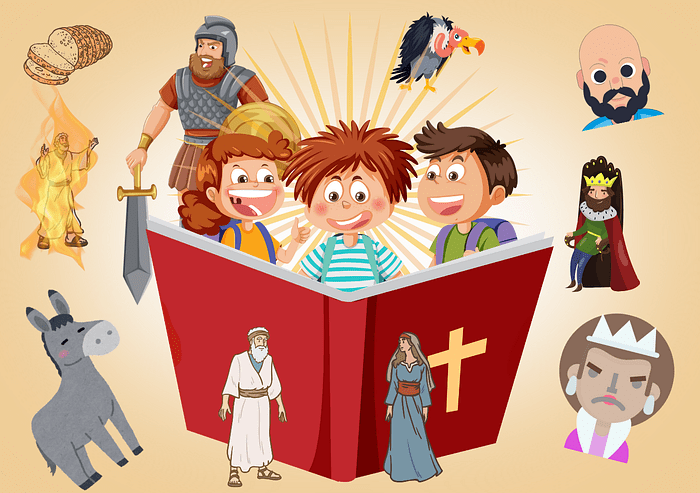
image created using Canva
The Bible is universally regarded as one of the best literary works of all time. Whether you believe it to hold the truth or not is immaterial. It is hailed for its exemplary literary merit. It has everything from poetry to prose, from dialogue to song, from epic to saga, etc. Its composition is an amazing achievement, and the stories in it are some of the wildest you will ever read.
Many of the Bible stories are undoubtedly popular. You do not have to be a Christian to know about Noah and the Ark, David and Goliath, or Moses and the Red Sea. Most of the world has certainly heard the story about the humble birth of mankind’s Savior.
There are 66 books in the Bible (73 if you are Catholic), so you can imagine the amount of stories included in it. Given the Bible’s extensive content, even long-time readers or diligent Sunday School attendees may not be familiar with all the scriptural anecdotes.
If you want to find out if there is one or more you might have missed, you can start with this list. Here are ten biblical stories that many people — Christians included — have probably never heard of.
(All links in this article lead to online sources that support the corresponding statements.)
10. The Poor Wise Man (Ecclesiastes 9:15)
This is barely an anecdote. The entire business is related in just a couple of verses. In a nutshell, a powerful king tried to occupy a small city with an equally small population. In this city, there happened to be a poor, wise man, and he ended up saving the city with his wisdom. Still, for all his effort and the triumph it produced, nobody remembered him.
That’s it. I suppose you can add nanofiction (or nanoparable in this case) among the literary forms that the Bible covered. It is a sad short story that is sorely lacking in details. Many would probably love to know exactly what his wisdom told the city to do. I have no idea how this little tale is supposed to be inspiring, but many Bible scholars compare it to the reception that Jesus Christ got.
9. Ehud (Judges 3:12–30)
This one is gory in so many ways. It has blood, guts, and other gross biological matter. The same could be said for the entire book of Judges. The Bible, or at least its message, is supposed to be for everyone, but cozy readers might just have a harder time with it. On the other hand, readers of A Game of Thrones would be quite comfortable with this material.
Ehud was a judge when Israel was under the Moabites. The biblical judges are not to be confused with modern day ones. Instead of presiding over the court of law, the Old Testament judges were like tribal chieftains.
When Ehud was tasked to bring the Israelites’ annual tribute to Eglon, the Moabite king, he crafted a short double-edge sword. Ehud happened to be left-handed, which is considered a tactical combat advantage. He could conceal the sword on his right thigh and strike with it using his left hand, both typically unexpected by opponents.
Ehud told Eglon that he had a secret message for the king, so Eglon dismissed his entourage. He led Ehud to some kind of royal bathroom and conferred with the judge while seated in another kind of throne. Apparently, this was not considered disgusting back then; people, particularly monarchs, habitually took a dump with an audience. Long story short, Ehud stabbed Eglon in the abdomen so hard, he dislodged the king’s feces. He quickly locked the room and got out of dodge, and then he rallied the Israelites to attack the Moabites.
8. Korah (Numbers 16)
This tale is also a doozy. It shows you how politics and all its ugliness have always existed, even in the wilderness with a makeshift government. Korah was a fellow Levite (the tribe of priests) and cousin to Moses and Aaron. His beef with his cousins was mainly about Aaron being appointed High Priest.
Aggrieved to have been overlooked, Korah, who had a very high opinion of himself, staged a rebellion against Moses’s leadership. He got together a bunch of other troublemakers, and they accused Moses of nepotism. They said that Aaron’s appointment was not really from God and that they should all be High Priests. It did not end well for Korah and his gang because God, not Moses, did choose Aaron.
In this cautionary tale against those who disrespect and challenge divinely-appointed authorities, Korah and the other ringleaders, plus their families and possessions, were swallowed up by the earth. Meanwhile, the other High Priest-wannabes were burned alive.
7. Balaam (Numbers 22–24)
You would think a story with a talking donkey would be a lot happier, but this should really have come with a trigger warning. If you cannot stand animal cruelty, thank your Sunday School teacher for skipping the tale of Balaam.
In a nutshell, Balaam was bribed by Moabite King Balak to curse the Israelites for a reward. Balaam said he would only do what God would tell him to do, but God could see his greedy heart. When Balaam went with Balak, an angel blocked his path. While he did not notice the angel, his donkey did and refused to move forward. Further revealing just how much of a degenerate he really was, Balaam proceeded to beat the poor animal. God allowed the donkey to speak in protest.
So, this is where the story gets confusing. Despite all attempts of King Balak to make Balaam curse the Israelites, the prophet only ended up blessing them. He followed God; he did not get the bribe from Balak, so why was he known as one who renounced his beliefs for material gain? Anyway, he ended up dying in battle while fighting on Balak’s side. Go figure.
6. Giants in the Bible (Genesis 6:4)
Everyone knows about Goliath, but many assume that he was a singular freak of nature. According to different accounts in the Bible, there were actually quite a number of them. They were allegedly descended from Nephilim, who were, also allegedly, the offspring of angels (some qualify them to be “fallen” angels) and human females. Can this be considered a bit of monster erotica? In any case, the Nephilim were known for being extremely tall and mighty.
The Nephilim, according to one theory, were the ancestors of the Anakim, the tribe of giants encountered by the Israelites in Canaan. Goliath was allegedly an Anakim, which implies that he had some fallen angel in him. Still, here is another point of intrigue (the Bible is just lousy with it): Goliath was both an Anakim and a distant cousin of King David, his slayer. According to their genealogy, Goliath descended from the Moabite Orpah, the sister (not just sister-in-law!) of Ruth, from whom David (and Jesus!) descended.
5. Hosea and Gomer (Hosea 1–2)
This is hardly the Bible’s answer to Pretty Woman, but, yes, Gomer was a prostitute and Hosea was, while not a dashing billionaire, a respectable prophet. Instead of soliciting and falling in love with a whore (not slut-shaming, just being literal), Hosea simply obeyed God’s order for him to marry Gomer and expect to be cuckolded.
It must be a trip to have your lovelife be used by God to make a point. Instead of using a parable, God employed Hosea’s real and personal story to illustrate that He, just like Hosea with his wife, continued to love Israel, who was unworthy and unfaithful just like Gomer.
4. Queen Athaliah (2 Chronicles 22:10–23:15)
Talk about evil, ambitious women! Athaliah’s worse than Lady Macbeth because she was all about making herself — not her husband or son — ruler and ensuring that she remained in power for a long, long time. She is a legacy though, so it sort of makes sense. She is a descendant of a more famous biblical she-devil, being either the daughter or granddaughter (scholars differ in their analyses) of Jezebel.
In any case, Athaliah was from Israel and her marriage to Jehoram (possibly either her brother or nephew) sealed the treaty between her kingdom and Judah. Her hubby was actually a good match for her because not only did he choose to reject Yahweh, he also killed all six of his brothers to secure his ascendance to the throne.
Athaliah’s son Ahaziah became king when Jehoram died. Unfortunately, he himself died shortly thereafter. Then, his mother quickly seized the kingdom and proceeded to have all potential heirs to the throne, including her own grandchildren, murdered. Thankfully, her stepdaughter managed to rescue Ahaziah’s baby, Jehoash, and in the tradition of the sweet revenge trope that many of us love, this infant grew up to be crowned king and his wicked grandmother was killed.
3. Rizpah (2 Samuel 21)
The Bible is supposed to serve as inspiration and instruction, but since they are from a much earlier civilization, the stories can be so barbaric. Despite the fulfilment of God’s design, they are nowhere near the feel-good tales that typically inspire and motivate. Take Rizpah for instance.
During the early years of David’s reign, the kingdom suffered a famine. This calamity was blamed on Saul slaying the Gibeonites. When David asked what would compensate for this wrong, the Gibeonites asked for the life of seven of Saul’s descendants.
This was obviously a different time and culture. David picked two of Rizpah’s sons and five of Merab’s (Michal’s in a less accurate version). Rizpah, one of Saul’s concubines, had to endure this cruelty to pay for Saul’s sins. The poor mother stayed on a rock overseeing the suspended corpses of her sons and drove away scavenging beasts and birds interested in devouring the bodies. Rizpah’s heartbreaking sacrifice did contribute to the famine ending.
2. Elisha the Baldy (2 Kings 2:2–24)
Name-calling is for the ignorant and immature, and that is exactly what the boys in this story were. Still, having them mauled by bears for being insufferable brats is a tad too much. Or is it?
As the account goes, Elisha, on his way to Bethel, encountered some boys who bullied him, calling him “Baldy” and telling him to get lost. Elisha must have been pissed off, so, in the name of God, he sicced two bears on them.
It sounds like a bunch of little kids were ganging up on a grown man, but scholars surmised that these boys were actually man-sized youths. Also, if the two bears managed to get just 42 of them, that means there were so many more hecklers in that crowd. Some might consider that an alarming episode of aggression.
In such a scenario, Elisha would not have simply been disgruntled; he would have felt threatened. With no ancient cops to break up the mob, the bears had to do.
1. Ezekiel Bakes with Feces (Ezekiel 4:9–13)
This tale started out pretty promising with mentions of wheat, barley, beans, lentils, millets, and fitches (pungent black seeds). It sounds like the making of really good barley cake, but then the recipe called for the whole mess to be baked with “dung that cometh out of a man.”
It definitely became much less appetizing. Not to worry though, the recipe was actually amended and the prophet was allowed to use cow dung instead, which is only slightly less gross.
While the story should have come with a multiple-pathogen caution, its symbolism really targeted the Israelites, offering a portent of the defiled food they would be forced to eat in exile as a consequence of their sin. Incidentally, this infamous bread recipe is the inspiration for Ezekiel bread, the sprouted whole-grain loaf that many modern health buffs prefer to consume today. Thankfully, no dung is involved in the making of this product.
Fun little anecdotes, eh? Were you familiar with all of them? Which ones weren’t you aware of? And which ones do you wish you never found out about? Can you think of other obscure Bible stories to add to the list? Let me know!
Like this post? Remember, I have a tip jar at the footer! Hope you have a great one! 🙂



 This Small Life