I must have replied “doctor” because that’s what I heard most kids and adults say, but as soon as I started reading stories on my own, I knew I wanted to be a writer when I grew up.
I’m grateful to have grown up without the distraction of the online world. For amusement, I got to play with other kids or on my own. There was the TV (and I’m not going to pretend I didn’t watch a lot of it because I did as much as the five channels we got – three of them from the government, no UHF channels until I was a teenager, and no cable until I was in college) could entertain me.
I liked playing as much as the next kid, but I very early learned that I’d much rather get lost between the pages of a good book. I started building a personal library as early as the third grade. I held on to most of my books (no thanks to thieving friends who didn’t know how to return after borrowing) with the idea that my future children would want them someday.
I first had that intent 40 years ago, and, with my eldest turning 20 this year, I can say that the effort was worth it. It still is; I haven’t stopped hoarding collecting. I have noticed, though, that, while my kids enjoy my books, they don’t really think of them as the treasure trove I would have regarded them if I had grown up with the now-considerable reading reservoir.
No matter. I’m glad they have access to all the books that have engrossed, moved, and influenced me through the years. I’ve always been particularly eager for them to read my vintage Newbery collection (Newbery Medal and Honor winners). While I wouldn’t go so far as to say that every book that has won a Newbery is awesome, I do think that the odds of a book being good are very high if it has the Newbery stamp on it. In any case, I have written about the ones that I would recommend to any juvenile or adult reader. Have a gander.
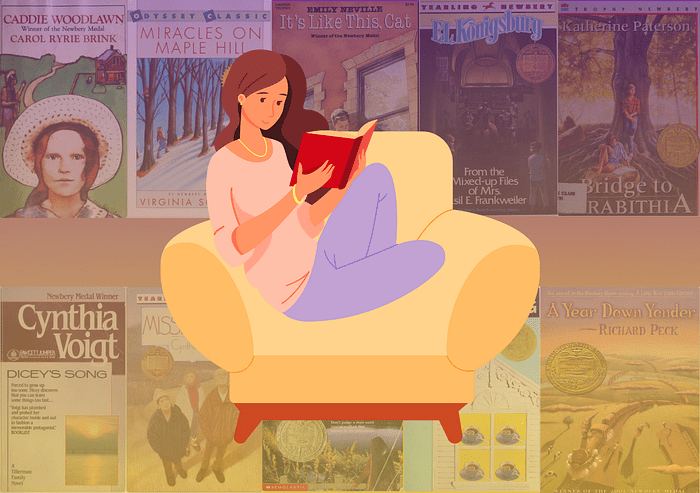
10 Newbery Awardees I’ve Read and Reread for More Than 30 Years Now
Bless your reading journey with these timeless Newbery Medal-winners.
Image created using Canva
I lie. There are definitely more than ten, but for the sake of making a conclusion possible, I’m limiting my discussion to just ten books.
I don’t remember the first time I read a story so good that I failed to completely shift back to the real world as part of me straggled in the make-believe world, interacting with the endearing and (sadly) fictional characters, and enjoying the oft-satisfying culmination of a story. This only means that it happened early in my life.
I have always had an affinity for books. I remember my delight upon learning that I had access to thousands of them at the library. I immediately became a regular patron, and I stayed a frequent and loyal user even after I discovered that I could begin my very own personal library. This happened when I was nine years old after my cousin gifted me with a copy of Sweet Valley Twins #4 — Choosing Sides. It was the beginning of an almost 40-year-old (and counting!) collection.
Being a child, I mostly read middle-grade books, and I quickly observed that many of those that really grabbed my fancy had a round logo of sorts on the cover, and they claimed to be a Newbery-something book. Naturally, I came to associate the Newbery label with quality reading.
I waited years before figuring out what the difference was between a Newbery Medal winner and a Newbery Honor book. At that time, I simply took the round logo — either silver (Honor) or gold (Medal) — as a guarantee of a worthwhile read.
Medal vs. Honor
Named in honor of John Newbery, an 18th-century children’s book publisher, the Newbery Medal is an annual literary award bestowed upon children’s literature deemed deserving by the Association for Library Service to Children.
Proposed in 1921 and inaugurated in 1922, the Newbery Medal is the world’s first literary award geared towards juvenile books. Besides the main winner, the recipient of the Newbery Medal, citations dubbed as Newbery Honors are also given to leading contenders for that year.
If you started your love affair with books young, chances are you’re already familiar with the featured books. Many of them have actually been adapted into film, so even if you haven’t read them yet, you might have seen their movie version instead.
My Personal Favorites
I understandably didn’t read the books chronologically, and, honestly, I’ve just barely scratched the surface. There are still so many that I haven’t read yet. Still, I’m going to list my own favorite Newbery Medal winners in the order that they won the award.
Set in the 1860s, Caddie Woodlawn is about a little tomboy’s series of adventures during a time when frontier life also faced the challenges of the Civil War. Although considered historical fiction, it doesn’t boast the heaviness that many books of the genre bear. Despite its levity, it’s not without its points of drama and trove of touching moments.
The book was inspired by the childhood of Caddie Woodhouse Watkins, the author’s grandmother. Ms. Brink later released a sequel titled Magical Melons, a copy of which I still have to get my hands on.
Caddie Woodlawn was adapted into a radio drama, a made-for-TV movie starring Emily Schulman (Harriet of Small Wonder), and a musical. To date, some 35 years after I first read it, I still like to slip my worn copy from its bookcase and peruse its pages to once again experience Caddie’s irrepressible spirit.
This is just the kind of story that makes me want to lose myself in its world. It has many elements that are just after my own heart: moving to the country, meeting so many enchanting characters, coming together for a worthy cause, overcoming inner battles… I simply love stories that make you feel good about the world and characters who manifest strength and goodwill.
Miracles on Maple Hill is about the transition that Marly and her family experience when they move from the city to the country. A fan of maple syrup, I enjoyed learning about the process of making it, but more than that, I appreciated the community dynamics demonstrated in maple syrup farming culture.
Ms. Sorensen wrote many books, both for children and for adults, but I’ve only ever read one other of her works, Plain Girl, which is about an Amish girl who was forced to attend public school. While I also liked it, I found Miracles on Maple Hill so much more charming and to my taste.
This book is another one that checks off so many of my interests or favorite things. I started young in my crazy cat lady ways, so I was delighted to be reading about the relationship between a young boy and a cat he rescued from the streets. There’s also an actual “crazy cat lady” in the story, a stereotyped character I typically find endearing.
The story takes place in early 1960s New York City, and it includes so many appealing details about the setting. There are beatniks in this book! Dave Mitchell, the main character, is your average teenager who manages to find interesting conflicts and adventures as he goes through the usual growing pains.
Incidentally, It’s Like This, Cat won in the same year that Rascal by Sterling North, another superb novel about a pet, was made a Newbery Honor Book. Both are terrific tales for those who love reading about animals.
This might have been the first Newbery Medal book that I read. I have my own copy now, but the first one I read was borrowed from the school library. This story involves a wonderful adventure that kids often imagine finding themselves in. Siblings Claudia and Jamie run away from home to live in the Metropolitan Museum of Art!
I may not have thought of staying overnight undetected at a museum, but I had often imagined squatting in a mall. It might be much trickier now with all the CCTVs, but back in the ’80s, I might have been able to hack it. Not that I ever needed to, but even now, my mind goes off on a tangent to cook up a possible game plan to get away with it. This story is perfect for kids who long for a non-dirty, non-outdoorsy, somewhat cushy adventure like Claudia does.
Ms. Konigsburg is one of my must-buy authors. Another one of her books actually received the Newbery Honor in the same year, and then she won the Newbery Medal again about a score later.
I hadn’t wanted to read this book again when I was a kid, as heartbroken as I was — no spoilers (although you probably at least already saw one of the film adaptations). I’ve reread it several times as an adult. While I’m able to manage my emotions better now, I still ruminate after, vacillating over how I would change things for a different outcome, which defeats the nature and aim of the book.
Ms. Paterson got a Newbery Honor the following year and won again a couple of years later. I loved Jacob Have I Loved as well, but it felt more like mature reading than a middle-grade book. The Bridge to Terabithia was more magical for me, underlining the specialness of having a friend who got you and could push you to explore your imagination and creativity.
I love the Tillerman Cycle, a series of novels by Cynthia Voigt following the journey of the Tillerman siblings. I first saw and loved the movie version of Homecoming (starring Anne Bancroft), the first book in the series. And then I scored a copy of Solitary Blue, the third book and recipient of the Newbery Honor, not realizing that it was related to Homecoming. Imagine my delight when I finally made the connection! Needless to say, I immediately worked on completing my collection of the Tillerman books.
Dicey’s Song is terrific, as excellent as the other books in the series, and you should read it — the entire series if you can find copies. What I want to share, though, is an anecdote about my and Ms. Voigt’s common denominator: Mr. Oviatt.
He was the head of the English department at the international school where I used to teach. A couple of years after I had resigned my post to focus on raising children, I was invited to speak as an author at the school’s Book Week. One of the students asked me who my favorite authors were, and since I was binge-reading the Tillermans at that time, Cynthia Voigt was the first to come to mind.
Upon hearing my answer, Mr. Oviatt told us that when he had been headmaster of a school in Maryland, he had hired Ms. Voigt to teach high school English. That’s one degree of separation! I was so thrilled that I thoroughly embarrassed myself with my excessive gushing. Oh, and rest in paradise, Mr. Oviatt. You were a cool mentor and an awesome human being.
I normally didn’t like (still don’t) books with such heavy themes, but I usually didn’t realize what I was in for until I was already invested in the story. The blurbs weren’t always forthcoming, and trigger warnings weren’t a thing back then.
As for Missing May, the topics of orphanhood and death came vis-à-vis a wry humor that I really enjoy. Add in a set of quirky characters, and I can find it in myself to weather the borrowed grief and heartbreak.
Whirligigs play an important symbolic part in the story, which is touching in itself, but I also loved the idea of them, their whimsical appearance, and how fun it was to say the word itself. I was already a schoolteacher when I first read this, and, despite my age, I still found it very insightful and moving.
Sharon Creech is another author I didn’t discover until I was a schoolteacher (whether as a student or a teacher, I found delightful refuge in the school library), but she immediately became one more must-buy author for me. Ms. Creech also has a Newbery Honor book, The Wanderer, which is actually the first that I got to read of her work.
Again, Walk Two Moons is another tale dealing with a heavy topic, but you really couldn’t be sure of it until you’re well into the story, and, if you’re like me, you’re hoping until the last minute that your suspicions aren’t correct. Again, I stuck it out because I enjoyed the storytelling and the fascinating characters.
I love this book in so many ways. It is told from five different perspectives, but I could relate to each one. Apparently, I have a teacher and four different kinds of geek in me. It’s always gratifying to read about distinctly different characters finding common ground (the academic bowl) and growing a strong friendship from that point.
Each main character has a personal tale of struggle and victory, and it’s satisfying to get to know all of them. The one other joyful thing about this book, as far as I’m concerned, is the trivia element. I grew up on Trivial Pursuit and Jeopardy, participated in school quiz bees and church Bible quizzes, etc. Trivia is my sport, and this book just makes me giddy with glee. And, if you’re into underdog stories, The View from Saturday will undoubtedly fill your heart.
Richard Peck is another favorite author of mine. Like many of his readers, I first fell in love with A Long Way from Chicago, which is a Newbery Honor book. I loved it so much that I couldn’t believe it didn’t win the Medal. When I checked, Holes by Louis Sachar, another beloved author, won that year. While I also love Holes, A Long Way from Chicago just cottoned more to me.
But this is about the sequel, and it’s just as wonderful as A Long Way from Chicago. A Year Down Yonder focuses on the time during the Great Depression when city girl Mary Alice was sent to live with her Grandma Dowdel (one of the most boss characters I have ever come across in literature) downstate from Chicago. Filled with memorably eccentric characters, this tale teems with amusing anecdotes nuanced by the presence of poverty and war.
Newbery Talk Ad Infinitum, Ad Nauseam
As per my initial warning, there are actually more than ten books I can recommend, like The Witch of Blackbird Pond by Elizabeth George Speare, whose The Sign of the Beaver is another choice read, or Dear Mr. Henshaw by Beverly Cleary, among many others, but this is already too long.
The books I feature are the ones that have completely captured my fancy. I understand that people have different preferences, but if you feel like you and I are both in the race that knows Joseph (deliberate allusion to the Anne of Green Gables series, personal favorites as well), then you’ll most likely adore these books too.
I have mentioned that there are Newbery Honor books I prefer to the recipient of the Medal, and that there are Honor books that are just as good as the Medal winner, but we would just have to put it down to really tough competition that year. Some winning authors also have books that I liked more than their work that got the accolade. For example, Thimble Summer by Elizabeth Enright is lovely, but I’m a bigger fan of her Melendy Family Series. Ultimately, it all boils down to taste, but if you’re picking up a book with one of the Newbery logos, chances are you will find it properly engaging.
I do have to admit that not all Newbery books are to my liking. For instance, I know people rave about A Wrinkle in Time by Madeleine L’Engle, but it was just not my cup of tea. Also, I haven’t read many of the more recent awardees. While I’d love to give them a whirl as well, The Girl Who Drank the Moon by Kelly Barnhill didn’t stir up the enthusiasm I have for the older titles. I still have a long list of more vintage Newbery books I want to read, so I’ll probably be prioritizing them.
I can clearly go on and on about the subject, but I have to conclude this piece at some point. You can take it for granted that, as long as this article is, it has already been snipped to death. I’m hoping somebody who shares this interest will comment so I can keep going in the threads. 😀
*This post is peppered with affiliate links. I’d really love for you to get your own copies of these amazing books. If you buy them through my links, I’ll get a very small commission at no extra cost to you. You pay the same price whether you buy using my link or not, but I do hope you use my links. 🙂


 This Small Life