It was market day at this dragonfruit farm up in the mountains. We traveled some two-plus hours to get there, the last stretch of the journey on a narrow dirt road that punished the underside of our vehicles. In our minds, the trip was worth it. We were able to score organic produce at a much lower cost straight from the source.
Truth be told, however, city slickers that we were (barely, but our city is part of Metropolitan Manila), we really went there to experience the farm itself – the crop, the animals, the stream that meandered through the property, the cooler mountain climate… We had opted to lunch there since the farm’s social media indicated that they offered it. However, it was during an important turning point for the place.
The farm had held market days before, but the staff had not expected the spike in popularity since the last one and the resulting number of people who showed up. We had to wait quite a while for lunch to be served. When it finally arrived, the first thing we noted was the blue rice.
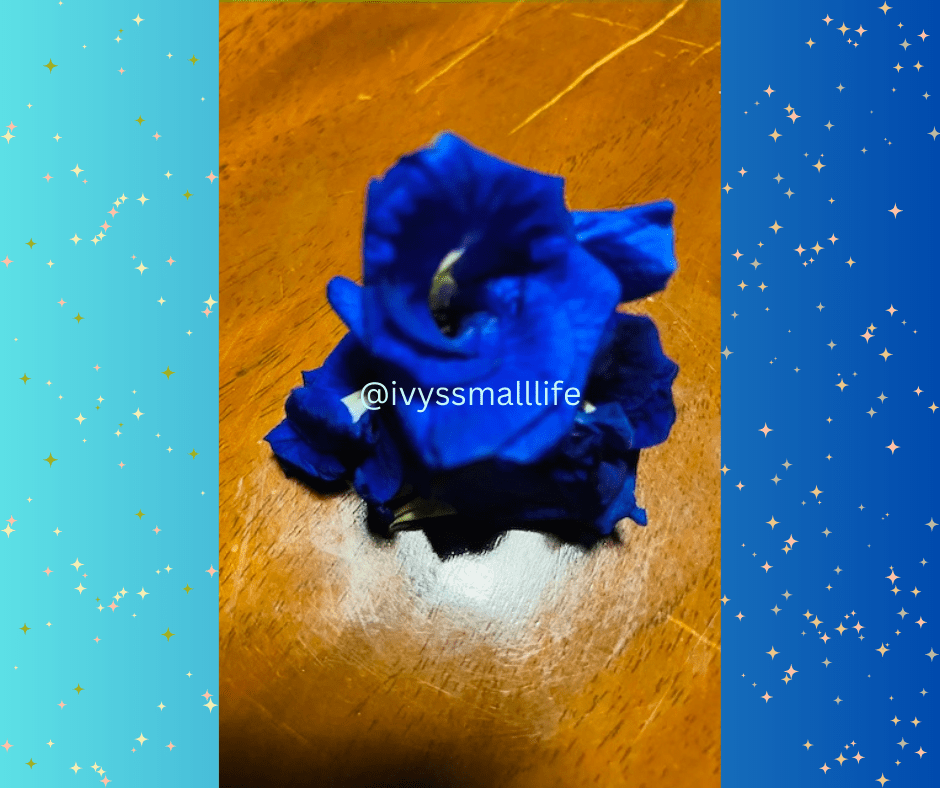
One of us gleaned from the staff that they used blue ternate flowers to color the grains. It wasn’t just for aesthetics either. The deep blue blooms supposedly offered a slew of health benefits. We trustingly nodded our heads, taking the server’s word for it. “They help improve your memory,” she added, intent on building up the virtues of the flowers and correctly assuming that this perk would appeal to us whose recollection abilities were already prone to glitching.
After eating, we waded in the stream. That very body of water claimed one of my husband’s slippers and one of my daughter’s. The current wasn’t really strong, but it was still too fast for any of us to overcome it and rescue said footwear. That mishap and our brush with red ants aside, it was an ideal idyllic day.
Before we left, the farm owner took my mom’s hand and placed in her palm a couple of pods in them. “Blue ternate seeds. Plant them,” he urged her. “They’re very easy to grow.”
He didn’t know my mother, however, and her relative notoriety for killing plants. I no longer remember if she had success germinating those seeds or not, but she went to Taiwan some time after and came back with a bottle of dried blue ternate flowers, not having any blue ternate plants of her own.
I wasn’t really interested myself in adding the plant to my garden, but one of the moms in one of my homeschool groups announced that her kid was selling blue ternate seeds from the lone seedling they’d purchased a couple of months before. “It turned itself into a mini-jungle; now we have seeds galore,” she shared in our chat, punctuating her pronouncement with a shocked emoji. Being the supportive community that we were, all the other moms ordered some. That’s how I got my first batch of blue ternate plants.
The dragonfruit farm owner was right. Barring the black thumb of the cursed, the blue ternate is stupid easy to grow. It’s very prolific, generously producing flowers and pods. If you let those pods drop, you can find new seedlings around the original plant. Or you can do as the enterprising homeschooler and gather the seeds to sell them. You can of course simply give them away or grow even more blue ternate plants.
Blue Ternate Facts
Where I am, they’re most commonly known as blue ternate or butterfly pea, but it goes by several monikers, the official one seemingly being Asian pigeonwings or, of course, its scientific name, Clitoria ternatea. Other common names include bluebell vine, cordofan pea, and Darwin pea.
A perennial, it’s native to equatorial Asia, which means it’s endemic to the Philippines. That could be why it grows so well here. I’m not really sure how well it thrives in other zones. Then again, it’s pretty resistant to disease and pests, so it might grow well in a greenhouse in a much colder place.
The blue ternate is considered a holy flower in India, one that is used for daily puja rituals. It is also medicinal and traditionally used in Ayurveda. Its purported beneficial properties include being anti-stress, anxiolytic (reduces anxiety), antidepressant, anticonvulsant, and nootropic (improves cognitive abilities like memory enhancement). It also has tranquilizing or sedative properties, making its tea good for bedtime.
The blue ternate extract is also said to have quite a number of pharmacological functions, including antimicrobial, anti-inflammatory, antipyretic (fever reduction and prevention), analgesic, local anesthetic, diuretic, anti-diabetic, insecticidal, etc.
Considering how well it colors food, the blue ternate flower is also used as a natural dye for textile and other fibers.
I’ve mainly been using the flowers to make tea, to color/enhance rice, and to add in salads. Apparently, however, you can also eat the pods while tender, fry the flowers (simply in butter or to make fritters), and to make fun drinks (the blue color reacts with acid – usually lemon juice – and changes to pink or purple).
Doesn’t this pretty plant endear itself to you? I only have the deep cobalt blue variety at this point, but there are also white, pink, lavender, and purple variants, so I feel compelled to get those too.
I recently featured the plant on a sorta blue-themed Instagram post:
What’s your favorite flower? What edible flower would you recommend having handy in the garden? Let me know in the comments. And again, if you’re going to follow me on Instagram from here, comment about it so I’ll know and follow back. 🙂
 This Small Life